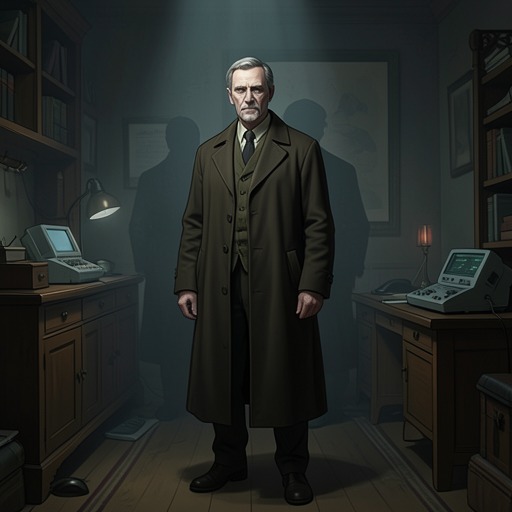
Jake's brother
I'm Thinking of Ending ThingsJake's brother is an absent but consequential figure whose troubled history emerges during a conversation in a moving car. Jake describes a sibling who struggled to relate to others, left a promising academic career, and began following and imitating him. The disclosure changes how The narrator understands Jake and Jake's parents, while remaining unsettled: the brother is described only through Jake's uncertain recollections, and the claim that he is now better does not resolve what happened or what their relationship became.
Identity and Disclosure
Jake's brother enters the conversation through a photograph. The narrator notices a man in the only picture that includes Jake's mother and finds the figure difficult to ask about. After a pause, Jake says that the man is probably his brother and that he thinks he remembers him appearing in one of the pictures. The identification is tentative, but it reveals a relationship that had not come up before. The narrator responds with surprise that Jake has a brother at all.
The scene establishes the limits of what can be known about him. He is not introduced directly, and the photograph does not provide an independent account of his identity. Instead, the reader meets him through a recognition that Jake himself presents as uncertain, followed by a story Jake is reluctant to tell. That distance matters: the brother's history is detailed enough to reshape the family story, but its terms belong to Jake's version of events.
Work and Social Difficulty
Jake dates the onset of his brother's problems to a few years earlier. He says the family initially did not think the situation was serious, in part because his brother had always been extremely solitary and had difficulty relating to other people. They thought he was depressed. Jake's account marks a change not as a single dramatic incident but as an intensification of a longstanding isolation.
His brother had been on track to become a full professor, but, according to Jake, could not manage the environment and had to leave his work. Jake distinguishes the brother's ability to do the job from the strain of its social demands: interacting with coworkers was too difficult, and the prospect of doing so brought a wave of anxiety at the start of each day. The difficulty was not simply that he disliked people. Jake says his brother liked them, but could not handle speaking with them, including the small talk expected in ordinary workplace life.
The contrast between professional promise and social distress is central to Jake's description. His brother could meet the work's intellectual demands, yet the surrounding interactions became unmanageable. Jake says his brother then needed another job, one without presentations and in which he could blend into the walls. The account does not say whether he found such work or how long he remained away from his academic position; it presents the search as part of a period when he was in a bad place.
Following and Disruption
During that period, Jake says, his brother began following him around. Jake emphasizes that the behavior was odd but not dangerous. He asked his brother to stop, but the following continued, leaving Jake with little recourse beyond cutting him out of his life and blocking him out. In Jake's telling, withdrawal becomes a response to a repeated boundary being ignored, even as he stresses that his brother could take care of himself and was not, in his view, dangerously mentally ill.
The following was accompanied by a more intimate intrusion. Jake says his brother talked to him, gave him orders and ultimatums, and was always present like a voice in his head. He describes the effect as interference with his life, a kind of sabotage made up of subtle actions rather than a single overt act. When The narrator asks for an example, Jake identifies one: his brother started wearing Jake's clothes. The detail makes the disruption concrete while also sharpening the uncertainty around it. Jake frames the behavior as part of his brother's problems, but does not explain what the clothing meant to his brother or what happened when he wore it.
As he recounts the episode, Jake turns up the radio slightly, despite the conversation, and begins to accelerate without seeming to notice how fast they are going. These details place the disclosure inside a strained present-tense exchange: The narrator presses for more information, while Jake answers and appears to try to move away from the subject. They do not establish a definite motive for his behavior, but they give the telling a physical tension that matches the difficulty of discussing his brother.
Relationship and Family
Jake says the brothers were never especially close, though they got along. Their shared intelligence and competitiveness created a bond, but did not guarantee that Jake understood his brother. He says he never saw the illness coming and wonders whether he ever really knew him. The statement complicates the earlier image of a brother whose longstanding solitude seemed legible to his family: even kinship and familiarity, Jake suggests, did not make the change predictable or make the person fully knowable.
Jake also describes his brother's loneliness as more than a label. He says his brother became very sad and very lonely, needed things, and asked for things Jake could not help with. Jake acknowledges that prolonged isolation is difficult and that a person can live that way only for a while. Yet the limits of his account remain visible: he does not specify what his brother asked for, or what support might have been possible. He presents the inability to help as part of the estrangement without resolving responsibility for it.
For Jake, the brother's difficulties changed the family dynamic. The narrator says that hearing this account makes Jake and Jake's parents more understandable, and recognizes that it may affect how she sees her relationship with Jake. The conversation therefore reveals more than a concealed sibling: it supplies a context for the family while showing that the context is partial. Jake says the situation is no longer a big deal and that his brother is better, all better, but the narration does not independently confirm that assessment or explain what being better entails.
Narrative Role and Uncertainty
Jake's brother alters the meaning of earlier family details without appearing in the present scene. His disclosure arrives through a photograph, an awkward pause, and an account punctuated by The narrator's questions. The structure makes knowledge itself part of the subject: a family relationship can remain unmentioned, and even a brother who once shared a bond with Jake can become someone Jake says he may never have truly known.
The brother's story also resists a neat account of illness and recovery. Jake uses terms such as problems and illness, recalls the family's initial belief that the issue was not serious, and insists that his brother is not dangerously mentally ill. He also describes concrete distress, occupational loss, social anxiety, loneliness, following, and behavior that intruded on his own life. Those elements coexist without a diagnosis or a complete chronology. Jake's confident claim that the situation is over sits beside his account of a relationship that was cut off and of needs he could not meet. The brother remains important precisely in that unresolved space: as the person whose absence helps explain the family, and as someone whose inner life cannot be recovered from Jake's account alone.